Linear Programming: Balance Engagement and Diversity in News Recommendation

Balance Popularity with Diversity in News Feed Selection Using Integer Linear Programming
A simple and transparent integer linear programming framework to achieve multi-objective optimization: diversity and popularity for online news platform.
1. Abstract
Online news platforms aim to maximize user engagement while maintaining topical diversity to ensure balanced content exposure. A purely prediction-driven ranking strategy—selecting the top K articles by predicted popularity—may concentrate content within a narrow set of high-performing topics, thereby reducing diversity.
This project develops a predictive–prescriptive analytics pipeline that integrates machine learning and integer linear programming (ILP) to study the trade-off between predicted popularity and topic diversity. A supervised learning model predicts article shares, and an optimization framework selects homepage articles subject to diversity constraints. Trade-offs are analyzed via Pareto frontier and sensitivity experiments.
2. Project Details
2.1 Objective
This study addresses the following research question:
RQ: How much predicted engagement will be sacrificed to increase topical diversity in homepage article selection?
2.2 Dataset
This project uses the UCI Online News Popularity dataset, which is fetched
programmatically. No manual download required.
2.3 Project Outline
The project mirrors a real-world decision-support workflow in digital media platforms. I replicate a predictive–prescriptive pipeline as follow:
Build a predictive model for article popularity.
Formulate an integer linear program to select K articles following the diversity constraints across topical categories.
Quantify the trade-off between popularity maximization and diversity.
Evaluate prediction and ILP model robustness across simulations and parameter variations.
3. Methodology
3.1 Preprocessing
Standard feature scaling on predictors and log-transformation on target variables
Selection of content features for model simplicity and reduce collinearity
Train–test splitting
Reproducible modeling via controlled random seeds
3.2 Predictive Modeling
An XGBoost regression model is trained to predict article shares. Performance metrics:
Root Mean Squared Error (RMSE)
Coefficient of Determination (R²)
Predicted shares serve as inputs to the optimization stage.
3.3 Integer Linear Programming (ILP) Formulation
3.3.1 Problem Formulation
After predicting article popularity using XGBoost, the homepage selection problem is formulated as a binary Integer Linear Programming (ILP) model.
3.3.2 Phase I: Fixed-Diversity Policy Model
To enforce editorial diversity, we first introduce a strict policy requiring that each category appear at least once.
This ensures that every category is represented at least once in the homepage selection. We solve this model across multiple random seeds (via re-trained XGBoost models) to assess:
Stability of selected sets
Opportunity cost relative to naive top-10 selection
3.3.3 Phase II: Parametric Diversity Model (Extended Solver)
The strict full-coverage policy may be overly restrictive in practice. To systematically study the trade-off between popularity and diversity, we generalize the model.
Due to incapacities to render math formulas on Framer, please view on GitHub repo.
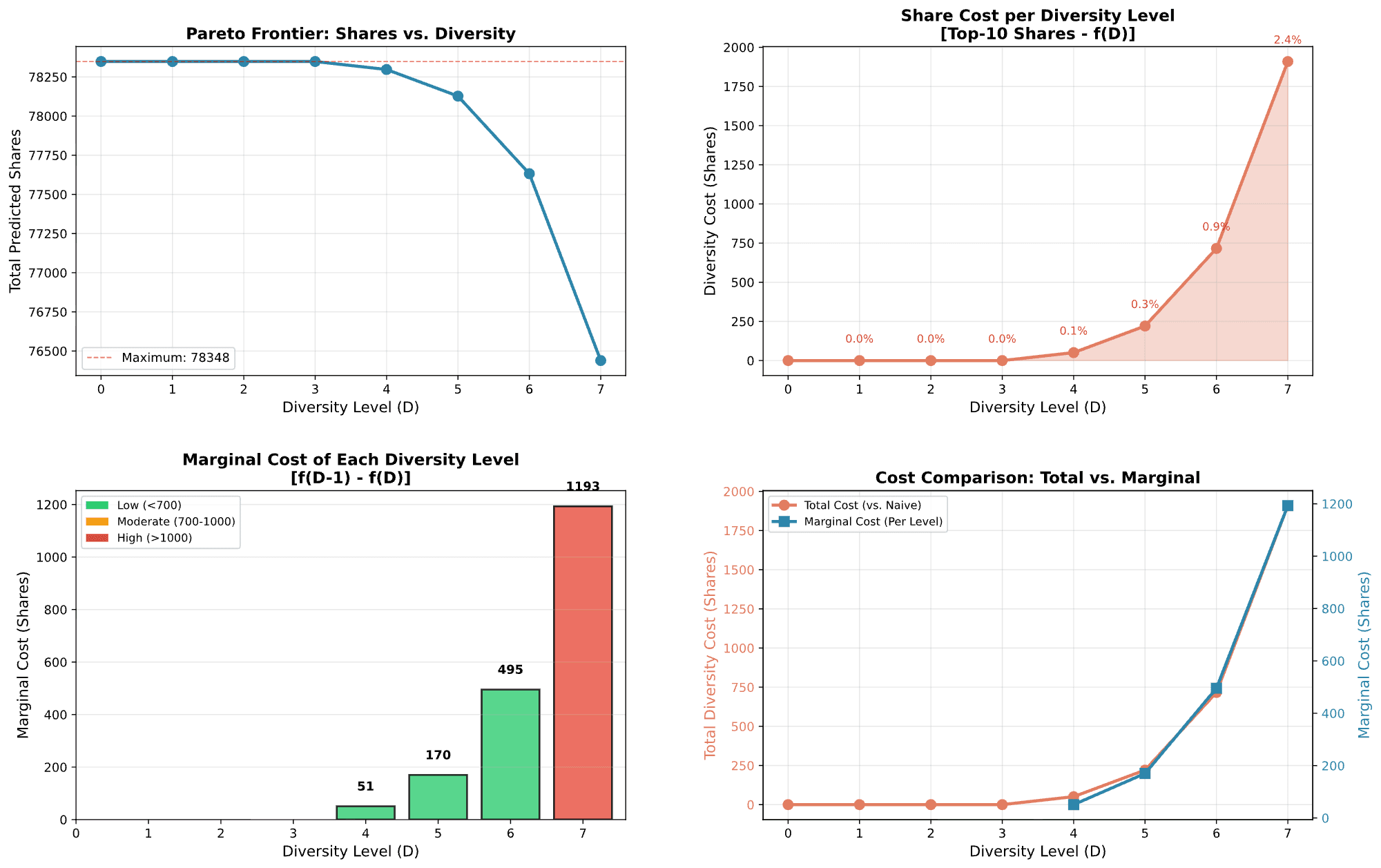
3.3.4 Trade-off and Pareto Frontier
By varying D (diversity level), we construct a Pareto frontier between:
Total predicted shares
Number of distinct categories
Each value of D corresponds to a policy scenario:
D=0: Pure popularity maximization
D=7: Full categorical coverage
Intermediate D: Balanced strategies
This enables quantitative analysis of the marginal cost of diversity:
Marginal Cost (D)=f(D−1)−f(D)
where f(D) denotes the optimal predicted shares under minimum diversity level D.
3.3.5 Managerial Interpretation
The parametric ILP framework allows decision-makers to:
Explicitly control diversity policy
Quantify the engagement cost of enforcing diversity
Select a policy level aligned with editorial or brand strategy
Rather than treating diversity as a binary constraint, the model enables systematic exploration of the diversity–popularity trade-off.
Results
Key findings:
Solution composition varies across random seeds but remains structurally consistent.
Moderate diversity (around 3-4 topics in the homepage) constraints incur minimal engagement loss while promoting topic diversity.
These results suggest that diversity can be increased strategically without substantial loss in predicted engagement.
Discussions
This study demonstrates the value of integrating machine learning with optimization: enabling policy-aware decision making.
The framework can be generalized to:
Content recommendation systems
Advertisement allocation
Fairness-aware ranking systems
Resource allocation problems with diversity constraints
Limitations
Dataset lacks temporal and personalization features.
Predictive model performance is moderate (limited R²).
Optimization relies on predicted shares rather than realized engagement.
Topic classification is represented via binary indicators rather than hierarchical taxonomy.
Future Work
Future extensions may include:
Robust optimization under predictive uncertainty.
Multi-objective optimization with fairness penalties.
Dynamic (time-aware) article selection models.
Personalized homepage optimization.
Bayesian modeling of prediction uncertainty.